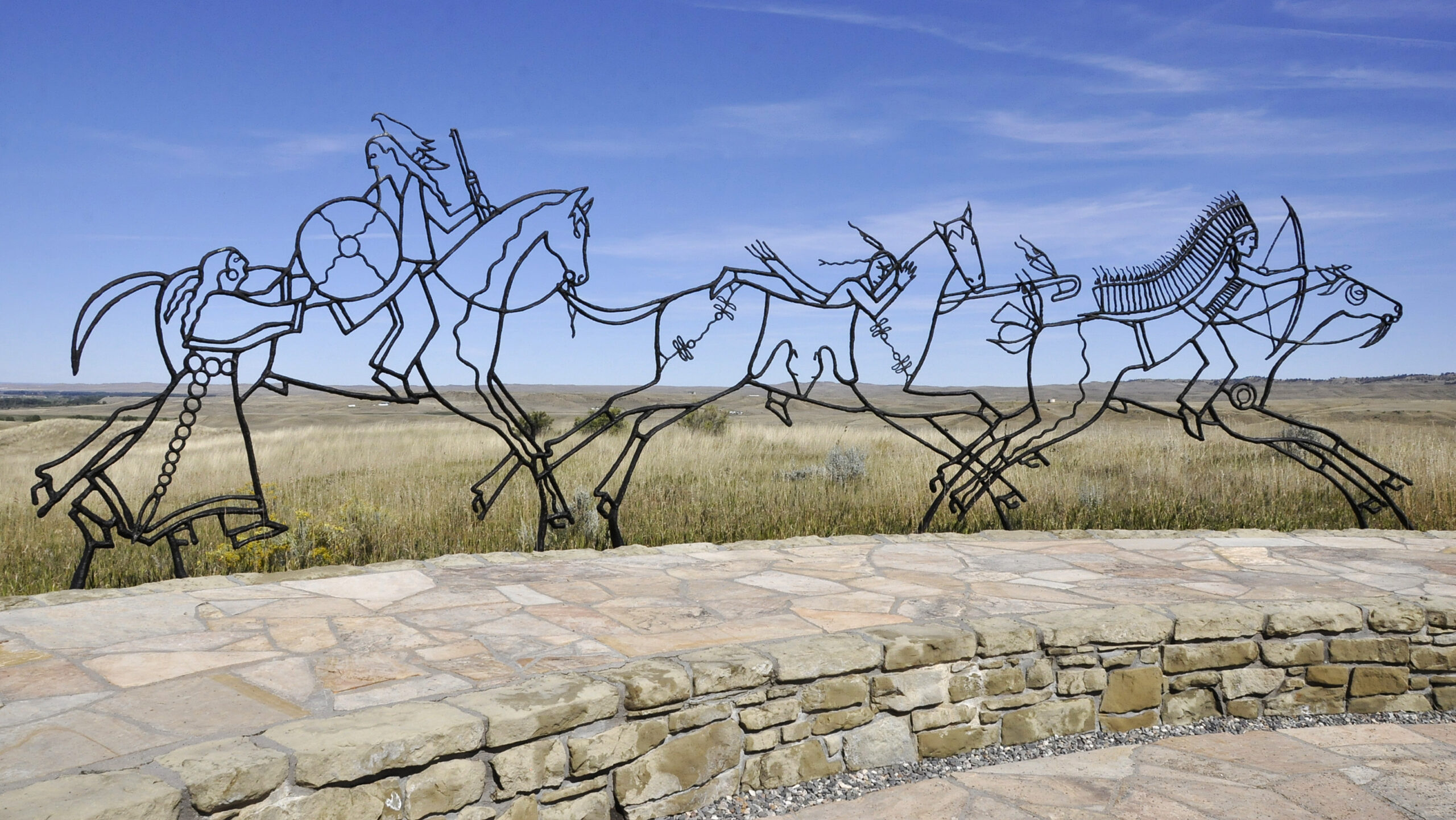
For over a century, the U.S. version of the Indian Wars has focused on military leaders, treaties, and territorial shifts. What’s often missing are the voices of the people who lived through it – especially the Cheyenne, whose land, culture, and survival were under constant threat.
While history books remember Custer and the famous defeat at Little Bighorn, they’ve overlooked a different kind of hero. A Cheyenne woman, brave and relentless, rode into two major battles and changed the course of history – not with rank or reputation, but with fierce loyalty to her people.
Her name was Buffalo Calf Road Woman. And her story has lived on through Cheyenne oral tradition, even as it was left out of mainstream history. Until now.
The Land Before the Invasion
For over a hundred years before American settlers pushed west, the Cheyenne called the Great Plains – and especially the Black Hills – home. They hunted, traded, and thrived alongside the Lakota and Arapaho, who became trusted allies in both peace and war. The land wasn’t just where they lived – it was sacred. It gave, and in return, they protected it.
But in the 1800s, the world began to change.
Treaties were signed with ink that quickly faded. Promises were made, then trampled underfoot. The Treaty of Fort Laramie in 1851 acknowledged tribal rights to these lands. But just seven years later, the discovery of gold in Colorado opened the floodgates. Miners, fur trappers, and farmers poured in under the guise of Manifest Destiny, with the government not only allowing it, but encouraging it.
By 1858, gold fever in the Colorado Rockies drew floods of settlers onto treaty-protected lands. The government looked the other way. When the Cheyenne fought back, they were labeled “hostiles.” But their aim was never conquest – it was protection. What the Army called rebellion, the Cheyenne knew as survival.
Sand Creek and the Breaking Point
In 1864, Colorado’s Governor John Evans gave settlers the green light to kill Native people deemed unfriendly, and placed Colonel John Chivington – a man known for hatred of Indians and ambition – in charge. That November, Chivington led his troops to Sand Creek, where a peaceful Cheyenne camp had gathered under assurances of safety. What followed was not a battle. It was a massacre of mostly women, children, and elders who were led to believe they were under Army protection.
Buffalo Calf Road Woman was still a child then, but the memory of Sand Creek would shape her life.
The Battle of the Rosebud: Where the Girl Saved Her Brother
As she grew, so did the pressure on her people. Treaties were made and broken. The Black Hills – guaranteed to the tribes under the Treaty of Fort Laramie – were stripped away once gold was found.
By the 1870s, the U.S. military shifted strategy: burn the camps, destroy the food supplies to force them onto reservations. Assimilation schools were built. Cultural traditions were outlawed. But the Cheyenne hadn’t forgotten who they were.
They were not ready to surrender – not their language, not their way of life, and certainly not their land.
And in the heart of it all stood a young woman named Buffalo Calf Road Woman.
On June 17, 1876, they met U.S. forces near Rosebud Creek in what’s now Montana. General George Crook expected to engage in a brief skirmish and push Native resistance back. What he got was a coordinated attack by nearly a thousand Cheyenne and Lakota warriors. The fighting lasted six hours, stretching across three miles.

As the fighting raged, a warrior named Comes in Sight had his horse shot out from under him. Alone on foot, he was vulnerable.
That’s when his sister rode in.
Buffalo Calf Road Woman didn’t hesitate. She galloped into open fire, pulled her brother onto her horse, and carried him to safety. The sight of her courage rippled through the fighters. The warriors rallied, their energy renewed. The U.S. forces retreated.
The Cheyenne would remember that day forever. They didn’t call it the Battle of the Rosebud. To them, it was “The Day the Girl Saved Her Brother.”
But her story didn’t end there.
Little Bighorn: The Real Story

The Battle of the Little Bighorn (1876): A 1898 Painting by Sioux chief Kicking Bear. In the middle of the picture are the chiefs Sitting Bull, Rain in the Face, Crazy Horse and Kicking Bear, and to the right of the red figure in the center is the defeated Custer.
Just eight days later came the battle Americans know best: Little Bighorn. To U.S. history, it’s “Custer’s Last Stand.” To the Cheyenne, it was something else entirely – a brief, hard-won moment of justice.
That’s how most of us learned it. A legendary cavalry commander overwhelmed by Native resistance. But the version passed down in Cheyenne tradition tells a fuller story.
Custer underestimated the Native forces. He thought there would be a few hundred warriors at most. Instead, there were well over a thousand – possibly as many as 2,500. The river swelled from rain the night before. The air was thick with heat and gunpowder. The sky was choked with smoke. Cheyenne, Lakota, and Arapaho, all prepared for what was coming.
None of Custer’s men survived. American historians have pieced together theories ever since. But the Cheyenne never had to guess.
They knew what happened. They told the story, passed it down.
After the Victories
According to their oral history, Buffalo Calf Road Woman rode into battle again, carrying a club and the rage of generations, in full view, refusing to take cover. She struck the blow that knocked Custer off his horse. She wasn’t alone, but she played a central role. Later, she and other Cheyenne women ensured no soldier walked away.
In American textbooks, Custer’s fall is a cautionary tale. But in Cheyenne tradition, it was a victory. A rare, shining moment when justice rose from the dust.
It wasn’t just a story of revenge – it was a story of defiance. Of reclaiming power, even if just for a moment.
And still, it wasn’t enough.
Despite the victory at Little Bighorn, the U.S. government responded with overwhelming force. Over time, the tribes were pushed onto reservations. Their children were sent to boarding schools. Their traditions banned. Their stories buried under official records that rarely told the whole truth.
Legacy

Yet the Cheyenne remembered. Buffalo Calf Road Woman’s role – long ignored in mainstream history – survived through the people who knew the truth.
Buffalo Calf Road Woman wasn’t just a battlefield hero. She was a mother, a sister, a protector, a, living legacy. She lived through broken treaties, massacres, and forced removals. And she still chose to fight -not just with weapons, but with unwavering loyalty to her people.6
Her story wasn’t told in schoolrooms. It lived in lodges and around fires, passed down by those who refused to let her name vanish.
Today, her courage is finally beginning to receive the recognition it deserves – not just as a footnote, but as a force.
Buffalo Calf Road Woman
Today, she’s remembered not just as the woman who saved her brother or brought down Custer, but as a symbol of resistance. Of survival. Of the deep power of Native women, so often overlooked by history, but never absent from it.
The Cheyenne never stopped telling the truth.
It’s time we finally started listening.
Disclosure: Some recommended reading links are Amazon affiliate links. If you choose to purchase through them, it helps support Off Beat History at no additional cost to you. Books are only included when they directly support the research and storytelling in the article.
Further Reading and Sources
For readers who want to explore more about Buffalo Calf Road Woman and the history of the Cheyenne people
Books
Stricken Field: The Little Bighorn Since 1876 by Jerome A. Greene (University of Oklahoma Press, 2008)
Lakota Recollections of the Custer Fight: New Sources of Indian-Military History by Richard G. Hardorff The fifteen Sioux (and one Cheyenne) who speak in Lakota Recollections of the Custer Fight witnessed Custer’s Last Stand. Their testimony sheds light on what happened at the Little Bighorn on the bloodiest of Sundays, June 25, 1876.
Cheyenne Memories of the Custer Fight: A Source Book by Richard G. Hardorff Brave Wolf and twelve other members of his tribe tell what happened in Cheyenne Memories of the Custer Fight, compiled and edited by Richard G. Hardorff. Between 1895 and 1908 naturalist George Bird Grinnell talked with Brave Wolf, American Horse, and other combatants at the Little Bighorn. Researcher Walter Mason Camp sought out Tall Bull, Bull Hump, and Little Wolf, whose voices are added to these pages.
Battle at the Rosebud: Prelude to the Little Bighorn by Neil C. Magnum An in-depth study by the Superintendent of the Little Bighorn National Monument of a little-known but important battle that took place a few days before the Battle of the Little Big Horn.
Cheyenne Memories by John Stands In Timber & Margot Liberty This classic work is an oral history of the Cheyenne Indians from legendary times to the early reservation years, a collaborative effort by the Cheyenne tribal historian, John Stands in Timber, and anthropologist Margot Liberty.
The Last Indian War: The Nez Perce Story by Elliot West Based on a rich cache of historical documents, from government and military records to contemporary interviews and newspaper reports, The Last Indian War offers a searing portrait of a moment when the American identity–who was and who was not a citizen–was being forged. (For wider Plains context, not Cheyenne-specific but excellent on U.S.–tribal conflicts)
Multimedia
American Indian Digital History Project: Buffalo Calf Road Woman Oral Histories https://www.aidhp.com
Cheyenne Primacy: The Tribes’ Perspective as Opposed to That of the United States Army; A Possible Alternative to “The Great Sioux War of 1876 by Liberty”, Margot Liberty, https://www.friendslittlebighorn.com/cheyenneprimacy
References
“Northern Cheyenne Reservation Timeline Northern Cheyenne Tribe 2017.” Montana Historical Society. Accessed 2 June 2025. https://mhs.mt.gov/education/IEFA/NorthernCheyenneTimeline.pdf
“Northern Cheyenne Reservation Timeline Northern Cheyenne Tribe 2017.” Montana Historical Society
“Fighting For the Black Hills: Understanding Indigenous Perspective on the Great Sioux War of 1876-1877.” National Park Service. Last Updated 26 July 2023. https://www.nps.gov/articles/000/fighting-for-the-black-hills-understanding-indigenous-perspectives-on-the-great-sioux-war-of-1876-1877.htm
“Colorado Governor Order ‘Friendly Indians to Report to Army Forts for Sanctuary History. Last Updated 31 Jan 2025. https://www.history.com/this-day-in-history/june-27/colorado-governor-orders-indians-to-sand-creek
“Northern Cheyenne Reservation Timeline Northern Cheyenne Tribe 2017.” Montana Historical Society
“Woman Warriors of Little Bighorn.” League of Women Voters of Indiana. 18 Nov 2024. https://www.lwvin.org/content.aspx?page_id=5&club_id=42001&item_id=107979
Leave a Reply