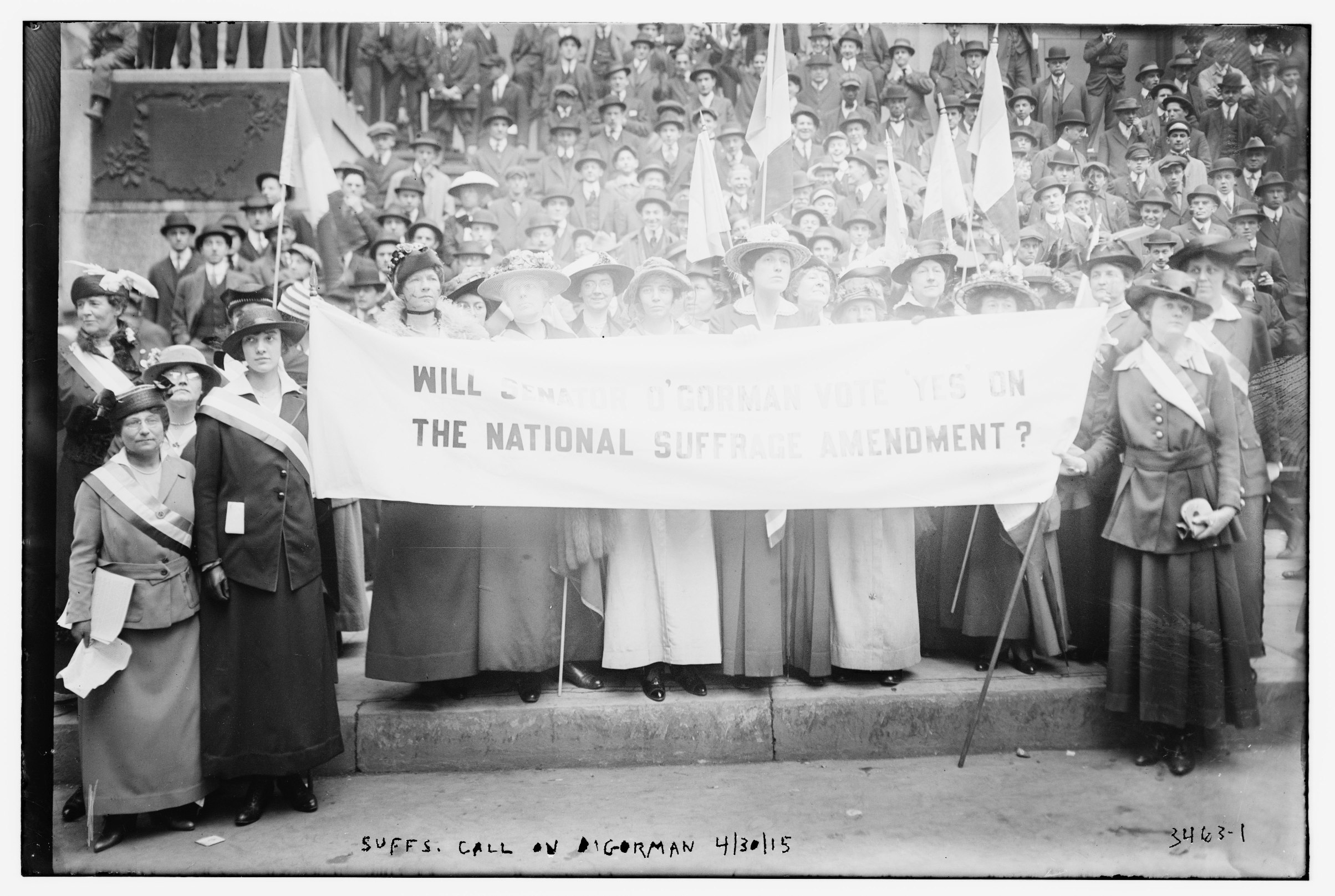
It took seventy-two years, two rival factions, and one mother’s letter to give American women the vote. The 19th Amendment marked a turning point, but not the end of the fight. From Seneca Falls to Tennessee, this is how persistence, protest, and politics reshaped democracy.
“Democracy could not truly exist when half the population had no voice.”
The summer heat hung heavy over Washington D.C. on August 26th, 1920, when Secretary of State Bainbridge Colby certified the 19th Amendment to the U.S. Constitution. With the stroke of a pen, millions of American women gained – at least on paper – the right to vote.
It was a victory seventy-two years in the making, born of persistence, sacrifice, and conviction.
But this triumph did not arrive easily, nor did it arrive equally for all.
The Awakening: The Seneca Falls Convention and Early Women’s Rights

The story begins on a humid July day in 1848, in Seneca Falls, New York. Three hundred people – among them abolitionist Frederick Douglass – crowded into the Wesleyan Chapel to hear Elizabeth Cady Stanton read aloud her Declaration of Sentiments.
Modeled after the Declaration of Independence, it began with words that would echo through the decades:
“We hold these truths to be self-evident: that all men and women are created equal.”
Radical words for a society that expected women to remain silent.
Those who attended risked their reputations, yet something had been set in motion – a spark that would become a flame. By 1850, suffrage conventions drew massive crowds.
At Brinley Hall in Massachusetts, a two-day convention could barely contain the crowds who came to hear Sojourner Truth, Lucy Stone, and Lucretia Mott speak. These early suffragists weren’t just fighting for the vote; they were challenging the very foundation of how society viewed women’s capabilities, rights, and place in the world.
“The prolonged slavery of woman is the darkest page in human history.”
Elizabeth Cady Stanton, 1891
The Great Fracture: Suffrage Divides After the Civil War
“Progress is rarely a straight line – it loops, divides, and sometimes breaks before it mends.”
The movement’s path would prove anything but straight. In the aftermath of the Civil War, suffragists faced a moral and strategic crossroads that would split them apart.
In 1866, the 11th National Women’s Rights Convention formed the American Equal Rights Association, uniting those who sought equality “irrespective of race, color, or sex.” For a brief moment, it seemed the causes of women’s suffrage and Black civil rights would march forward together.
But Reconstruction and the 15th Amendment shattered that alliance. The amendment granted voting rights to Black men while remaining silent on women. Some suffragists, including Frederick Douglass himself, argued that Black men’s enfranchisement should take priority. Others, including Stanton and Susan B. Anthony, refused to accept that women’s rights should wait any longer.
The disagreement grew bitter, personal, even ugly. In their desperation, some white suffragists deployed racist rhetoric, arguing that educated white women deserved the vote more than formerly enslaved Black men. It was a stain on the movement that would have lasting consequences.
From this fracture emerged two competing organizations. The National Woman Suffrage Association (NWSA), led by Stanton and Anthony, took a more militant stance, pursuing a federal constitutional amendment and a broad agenda of women’s social equality. The American Woman Suffrage Association (AWSA), led by Lucy Stone and Julia Ward Howe, among others, supported Black men’s voting rights first and adopted a cautious, state-by-state approach.
For two decades, they operated in parallel, united in purpose but divided in practice.
The Long Campaign: Reunification and Relentless Work
“Year after year, they built a movement one petition, one parlor meeting, one speech at a time.”
In 1890, pragmatism prevailed. Out of division, came renewed determination – and a recognition that unity was essential for success. The two groups merged to form the National American Woman Suffrage Association (NAWSA), with Stanton and Anthony at the helm. Their combined strategy pursued both a federal amendment and state campaigns, recognizing that progress wherever it could be found was still progress.
The work was exhausting and often dispiriting. Year after year, suffragists organized, lobbied, educated, and agitated. They faced hostility, ridicule, and endless setbacks – but still organized, petitioned, and marched through every storm. Social expectations of proper womanhood weighed heavily – many were told they were abandoning their natural roles as wives and mothers, that politics would corrupt their gentle natures, that they simply weren’t capable of understanding complex civic matters.
But they persisted. And as the century turned, Anthony passed leadership of NAWSA to Carrie Chapman Catt, who brought organization and political savvy to the cause. A changing of the guard began.
“Failure is impossible.”
Susan B. Anthony, 1906
A New Generation, New Tactics: Suffrage in the 1910s
By the 1910s, younger suffragists grew restless with what they saw as the movement’s mild-mannered approach.
Led by Alice Paul and Lucy Burns – women who had witnessed the more militant tactics of British suffragettes – this new generation believed different methods were needed.
Paul and Burns focused exclusively on a federal amendment rather than scattered state victories. They organized dramatic protests, hunger strikes, and became known as the Silent Sentinels for their peaceful but persistent picketing outside the White House gates, even during World War I.
When arrested, they went on hunger strikes and were force-fed. Their courage made national headlines.
“There will never be a new world order until women are a part of it.”
Alice Paul, 1920


Meanwhile, Catt orchestrated a multi-pronged strategy she called the “Winning Plan,” simultaneously organizing state amendment campaigns while lobbying relentlessly in the Capital. Her diplomatic approach and political savvy unified disparate factions and shaped a cohesive national campaign.
It was the combination of Paul’s public pressure and Catt’s political maneuvering that finally moved the needle. In 1918, President Woodrow Wilson, who had long been lukewarm on the issue, announced his support for the amendment. The constant visibility of the cause – in the streets, in the press, in the halls of power – had become impossible to ignore.
The War of the Roses: Tennessee’s Decisive Vote for Women’s Suffrage
“One letter. One vote. Half a nation freed.”
Even with presidential support, victory remained elusive. The proposed amendment languished in Congress for two more years, forty years after it was first introduced. Both chambers had to pass it, and the votes were agonizingly close.
When Congress finally approved the amendment in June 1919, the battle shifted to the states. Ratification required approval from thirty-six states, and by the spring of 1920, thirty-five had voted yes. After decades of strategy, setbacks, and shifting leadership, the final test came not on the streets of Washington but in the Tennessee statehouse.
That summer, lobbyists and activists from both sides descended on Nashville. The atmosphere was tense, theatrical, almost carnival-like. Pro-suffragists wore yellow roses pinned to their clothing; the opposition wore red. Both sides lobbied legislators fiercely, hosting dinners, making promises, applying pressure.
On August 18, 1920, the Tennessee House of Representatives prepared to vote. The outcome appeared to hinge on a single vote. State Representative Harry T. Burn, a twenty-four-year-old Republican, wore a red rose – the symbol of opposition. His party expected him to vote no.
But Burn carried something else in his pocket that day: a letter from his mother. Febb Burn was an educated, well-read, politically informed woman who understood what was at stake. “Help Mrs. Catt with her ‘Rats.’” she had written, urging him to vote for ratification.
When his name was called, Burn voted “aye.”
His single vote changed the course of history. Tennessee became the thirty-sixth state to ratify. Eight days later, the 19th Amendment became law.
The Incomplete Victory: Barriers After the 19th Amendment
“The door had opened – but many were still forced to wait outside.”
The celebration, however, told only part of the story. In some places, women had already assumed the right long before 1920 – Wyoming, Utah, Colorado, and Idaho led the way in the 1800s. Yet for many women of color, the 19th Amendment changed little.
In the South, states simply ignored the amendment’s requirement, just as they had ignored the 15th Amendment’s prohibition on racial discrimination in voting. Black women were systematically barred from the ballot through poll taxes, literacy tests, grandfather clauses, and felony disenfranchisement laws. White women gained access to voting booths; women of color were met with intimidation, violence, and legal obstruction.
Native American, Latina, and Asian American women also encountered discriminatory laws and cultural barriers. True universal suffrage remained out of reach until the Civil Rights Movement of the mid-20th century. The 19th Amendment opened the door – but many still stood outside.
The concept of truly universal suffrage – granting voting rights to every American regardless of gender, race, or background – was considered too radical in 1920. Those in power couldn’t imagine sharing it so broadly. Social attitudes held firm that certain groups simply weren’t capable of or deserving of full citizenship.
“Nobody’s free until everybody’s free.”
Fannie Lou Hamer, 1964
Why It Mattered: Power, Personhood, and Progress
“They weren’t asking for privilege – only the power to define their own lives.”
The fight for suffrage was never just about casting a ballot. It was about fundamental human dignity and autonomy.
Before 1920 American women – especially those who were married – had few legal rights. They couldn’t take legal action without a man’s consent, own or inherit property, and her earnings legally belonged to her husband. Access to higher education was restricted, and most professions were closed to women entirely.
Women had no representation in forming the laws that governed their lives. Society expected them to marry and confine themselves to the domestic sphere, to be wives and mothers, nothing more. Their value was measured by their relationships to men, not by their own capabilities or aspirations.
This forced dependence created a system where women had to rely on fathers and husbands for financial and social survival. A harsh double standard governed morality, judging women far more severely than men for the same behaviors. Gender, not capability, determined life’s possibilities.
When women could work, their options were severely limited, and they earned a fraction of what men did for the same labor. These weren’t just unfortunate circumstances – they were deliberate legal and social structures designed to keep women subordinate.
The early suffragists understood that none of this could change without political power. They questioned what society told them not to question, and in doing so, they didn’t just win the vote. They proved that citizenship should not be gendered. They fundamentally challenged the idea that any group of people should live without a say in their own governance.
“The ballot is the power by which good laws may be secured and bad laws abolished.”
Frederick Douglass, 1888

Legacy: The Vote as a Key to Every Other Right
“They changed more than laws – they redefined democracy.”
The 19th Amendment stands as a milestone in America’s ongoing journey toward its founding ideals. The suffragists’ seventy-two-years struggle teaches us that progress is rarely linear, quick, or clean. It takes coalition, conflict, and relentless persistence.
The women who marched, starved, and strategized for decades changed more than laws, they redefined democracy itself.
The story of women’s suffrage is also a reminder that legal victories don’t automatically translate into lived equality. The work continues long after the amendment is ratified, the law is passed, the declaration is signed. Rights must be defended, expanded, and made real.
Yet on that August day in 1920, something profound shifted. The impossible had become real. Women who had been told they were too delicate, too irrational, too limited to participate in democracy had proven otherwise. They had organized, strategized, suffered, and prevailed.
Harry T. Burn’s mother understood what her son’s vote meant. So did the millions of women who had fought for this moment and the millions more who would inherit it. The right to vote wasn’t everything, but it was the key that could unlock every other door.
And seventy-two years of struggle had finally turned that key.
“The vote is the emblem of your equality, women of America, the guarantee of your liberty.”
Carrie Chapman Catt, 1920
Citation Note
All quotations from Stanton, Douglass, Anthony, Paul, Catt, and Hamer are drawn from public-domain speeches and writings.
Modern interpretive text © Amber, Off Beat History.
Disclosure: Some recommended reading links are Amazon affiliate links. If you choose to purchase through them, it helps support Off Beat History at no additional cost to you. Books are only included when they directly support the research and storytelling in the article.
Recommended reading to learn more about the Suffragettes and their journey
Secondary and Contextual Reading
Suffrage: Women’s Long Battle for the Vote by Ellen Carol DuBois Distinguished historian Ellen Carol DuBois begins in the pre-Civil War years with foremothers Lucretia Mott, Elizabeth Cady Stanton, Susan B. Anthony, and Sojurner Truth as she chronicles the links of the woman suffrage movement to the abolition of slavery.
Votes for Women! The Woman Suffrage Movement in Tennessee, the South, and the Nation by Marjorie Spruill Wheeler Professor Marjorie Spruill Wheeler uses primary documents and accounts to bring the past to life by examining both the national and southern struggle suffragists faced. Also included are discussions of anti-suffragist beliefs and literature, the obstacles to woman suffrage in the South posed by white supremacy and state’s rights.
African American Women in the Struggle for the Vote, 1850–1920 by Rosalyn Terborg-Penn Professor Rosalyn Terborg-Penn presents a comprehensive look at the African American women who fought for the right to vote analyzes the women’s own stories and examines why they joined and how they participated in the U.S. women’s suffrage movement.
The Myth of Seneca Falls: Memory and the Women’s Suffrage Movement, 1848–1898 by Lisa Tetrault Professor Tetrault demonstrates that Stanton, Anthony, and their peers gradually created and popularized this origins story during the second half of the nineteenth century in response to internal movement dynamics as well as the racial politics of memory after the Civil War.
Women and the American Experience: A Concise History by Nancy Woloch Historian Nancy Woloch presents a comprehensive survey of U.S. women’s history from the seventeenth century to the present that illuminates the diversity of women’s experience and underscores the roles that women have played as agents of change.
Films
Iron Jawed Angels starring Hilary Swank, Frances O’Connor, and Julia Ormond
Suffragette starring Carey Mulligan, Helena Bonham Carter, and Meryl Streep
Primary Sources
Woman Suffrage and Politics: The Inner Story of the Suffrage Movement by Carrie Chapman Catt With candor and flashes of wry humor, Catt offers sharp insights into the social, political, and economic forces arrayed against her cause, revealing the strategies that finally brought the suffragists’ seven-decade campaign to dramatic victory.
Declaration of Sentiments (1848), Elizabeth Cady Stanton – National Park Service
Rightfully Hers: American Women and the Vote, National Archives Museum Exhibit
Harry T. Burn and His Mother’s Letter, Tennessee State Museum
Interactive and Archival Resources
Library of Congress, Women’s Suffrage Timeline
Smithsonian Institution, Votes for Women: A Portrait of Persistence Exhibition
National Park Service, Women’s Rights National Historical Park Virtual Tour
References
1. Verhovek, Kendall. “The 19th Amendment Explained.” Brennan Center for Justice. 3 Mar 2025. https://www.brennancenter.org/our-work/research-reports/19th-amendment-explained#:~:text=More%20than%20160%20years%20after,%E2%80%94%20on%20August%2018%2C%201920
2. “Women’s Suffrage.” History. Last Updated 28 May 2025. https://www.history.com/articles/the-fight-for-womens-suffrage
3. Alice Paul Center for Gender Justice. “Who Was Alice Paul?” Accessed 30 Oct 2025. https://www.alicepaul.org/about-alice-paul/
4. Fischer, Audrey. “Winning the Vote for Women.” Library of Congress. Accessed 1 Nov 2025. https://www.loc.gov/loc/lcib/9607/suffrage.html
5. Bomboy, Scott. “The Vote That Led to the 19th Amendment.” 18 Aug 2023. https://constitutioncenter.org/blog/the-man-and-his-mom-who-gave-women-the-vote
6. Kratz, Jessie. “Rightfully Hers: Woman Suffrage Before the 19th Amendment.” 15 Aug 2019. https://prologue.blogs.archives.gov/2019/08/15/rightfully-hers-woman-suffrage-before-the-19th-amendment/
7. Eisenberg, Bonnie, Ruthsdotter, Mary, 1998. “History of the Women’s Rights Movement.” National Women’s History Alliance. https://nationalwomenshistoryalliance.org/history-of-the-womens-rights-movement/#:~:text=Stanton’s%20version%20read%2C%20%E2%80%9CThe%20history,made%20totally%20dependent%20on%20men
Leave a Reply