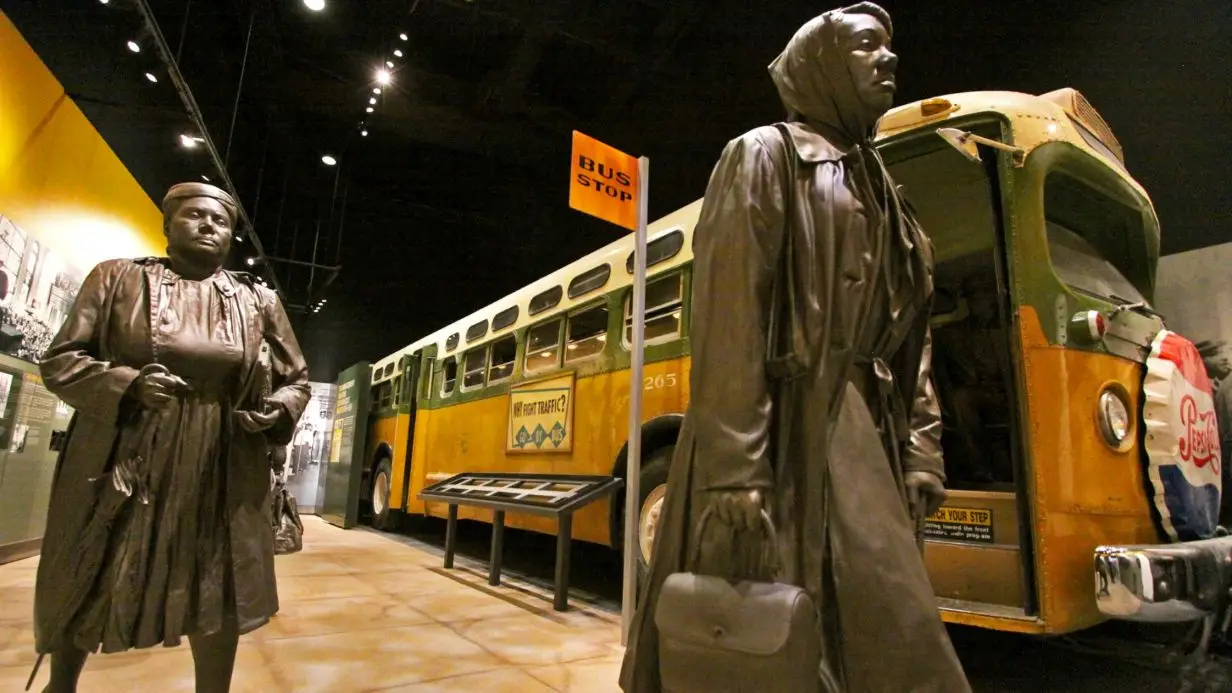
She was fifteen, tired, and on her way home. When the bus driver demanded she give up her seat, Claudette Colvin stood her ground, saying, “I paid my fare, it’s my constitutional right.” That moment – nine months before Rosa Parks made the same defiant stand—became one of the true historical origins of the Montgomery Bus Boycott. Let’s meet the girl history nearly lost.
Dusk spilled across Montgomery on December 1, 1955, when a seamstress named Rosa Parks dropped her dime into the fare box and slid onto the first row of the “colored” section. The seats for white riders filled, the driver barked his command. Rosa clasped her purse, lifted her chin, and answered in a voice soft as cotton but firm as iron: “No.” The bus rattled to a halt, yet the moment kept moving – out the doors, down Dexter Avenue, into church basements and kitchen-table meetings – until a 381-day boycott rose up and the country itself began to shift.
One woman’s quiet refusal set thousands of feet walking and millions of minds rethinking what freedom should look like. Rosa stepped off a segregated bus in Montgomery that evening, calm and resolute. History remembers that December evening, yet the spark that lit the boycott first flared nine months earlier – on the same city streets – inside a much noisier bus carrying a 15-year-old named Claudette Colvin….
Before Rosa Parks: Claudette Colvin’s First Stand
Diesel fumes drifted through the cracked windows of the Highland Gardens bus that March afternoon in 1955. Fifteen-year-old Claudette Colvin hugged her schoolbooks and slid into a seat just left of the aisle, dark curls pasted to her forehead by the Alabama heat.
“Y’all need to move back,” the driver barked, nodding at Claudette and three other Black passengers even though empty seats winked in the whites-only rows.

Claudette’s fingers tightened around her history textbook. Just that morning she’d stood in civics class and recited the Preamble; the words still hummed behind her ribs. Feeling the presence of Sojourner Truth and Harriet Tubman supporting her, she did not move.
“I paid my fare,” she said, voice steady. “It’s my constitutional right to sit here.”
A hush slid down the aisle. The driver’s jaw worked. Coins rattled as he slammed the brake and stomped off to flag a patrol car.
No siren was needed – the sight of two blue-uniformed officers climbing the steps drained the air from every lung on board. Although scared of what might happen to her and her family, she maintained her resolve against injustice.
“Girl, don’t make trouble.”
Trouble, she thought, was already here long before I sat down.
The officers jerked her upright, knocking her books out of her lap. As the men frog-marched her past rows of averted faces – some pitying, some frozen – she kept her spine straight.
Word of Claudette’s stand rippled through church basements and NAACP meetings, but leaders hesitated: she was young, dark-skinned, and soon discovered she was pregnant. Organizers waited for the ‘right’ test case. On December 1, 1955, it arrived in the form of Rosa Parks – older, lighter-skinned, already respected in Montgomery’s Black community. Within days, the Women’s Political Council (WPC) printed 50,000 leaflets that read, in part, ‘Another woman has been arrested…If we do not do something to stop these arrests, they will continue.’ The 381-day Montgomery Bus Boycott had begun.
The wooden benches inside the Montgomery courthouse creaked as Claudette rose to hear the verdict. She had come in wearing her Sunday dress and the stubborn certainty that the Constitution was on her side. “Guilty,” the judge declared, gavel cracking like a rifle shot. Probation, not jail – but the word itself clung to her name the way red dust clung to her shoes when she walked back home.
Within weeks the label “troublemaker” followed her everywhere. Store clerks glanced at her application forms and shook their heads before she finished writing. Taking time off from college seemed like the right choice given her challenging circumstances. Time off became withdrawal, and the classroom seat she’d once claimed with pride sat empty.
Setting the Stage: Montgomery Under Jim Crow
The injustice wasn’t abstract; she had watched it swallow someone she knew. Jeremiah Reeves – her classmate who could turn a drum solo into Sunday morning sunlight – had been hauled before an all-white jury, forced into a confession of raping a white woman he later recanted, and sentenced to die. When the state strapped him to the electric chair at twenty-two, Claudette felt the current run through her own veins: a warning and a vow.
The world had tried to shrink her future to a single word – guilty – but every closed door, every newspaper whisper, only sharpened her resolve to keep fighting the system that had stolen Jeremiah and now threatened to silence her.
Montgomery, spring 1955. Fifteen-year-old Claudette Colvin sat in the dusty light of Booker T. Washington High’s library, a law textbook open beside a copy of Paul Laurence Dunbar’s poems. Headlines about the Mau Mau uprising in Kenya bled across the front page of the Montgomery Advertiser on the table; she traced the map of Africa with her fingertip, hearing her civics teacher’s voice: “Oppression wears many uniforms.”
That morning the class had swapped essays for an assignment scrawled in chalk—How Do You Feel as an American?, and Claudette’s answer, several pages long, wove pride and fury into the same breath.

Outside the window a police cruiser idled, a reminder of the verdict that had killed her schoolmate Jeremiah Reeves weeks earlier. The memory of the electric chair made her stomach knot, but it also stiffened her spine. “Someday I’m going to be a civil-rights lawyer,” she whispered, almost daring the room to contradict her. The NAACP youth-council pamphlet folded in her pocket promised she wouldn’t have to fight alone.
Each afternoon, the walk home doubled as an inventory of injustice: whites stepping through the drugstore’s front door while she slipped to the back; a streetcar conductor spitting tobacco near an elderly Black veteran; another neighbor forced off a sidewalk. Every slight stacked like kindling. By the time she climbed the bus steps on March 2, the pile was dry and waiting for a spark. When the driver barked his order to move, Claudette’s earlier vow unfurled inside her like a banner: if the law would not protect her, she would grow up to wield it – and right now, at fifteen, she could begin by staying in her seat.
Ignored, Then Legalized: Turning Arrest into Lawsuit
Colvin refused to stay silent. She, along with Aurelia Browder, Susie McDonald, and Mary Louise Smith, became a plaintiff in Browder v. Gayle. When the three-judge panel ruled on June 5, 1956, that bus segregation violated the 14th Amendment, it was Claudette’s testimony that sealed the record. The Supreme Court affirmed the decision that November – exactly one month before the boycott ended.

On December 21, 1956 – 381 days after the first empty buses rolled through Montgomery – both Rosa Parks and Claudette Colvin stepped aboard newly integrated coaches. The city was quiet, the seats were open, and the two women who had never ridden together now shared a victory none could take away. Parks’s name would enter every textbook; Colvin’s would linger in footnotes for decades. Yet the boycott’s arc proves what their shared ride made plain: history is a relay, not a solo. One teenager’s defiance in March passed the torch to a seamstress in December, and together they lit the road toward civil rights.
Why Claudette Colvin Matters: Reclaiming History
Morning sun slants through the windows of a modern Montgomery classroom, pooling across desks where teenagers flip open laptops and history texts. Ms. Daniels, their teacher, holds up a yellowing newspaper head-lined BUS SEGREGATION OUTLAWED. In the grainy photo a slight girl, Claudette Colvin at fifteen.
“Look closely,” the teacher says. “She was your age, and she’d already memorized the Constitution.”
A murmur ripples through the room. One student lifts his hand. “So the boycott started with a kid who did her homework?”
“Exactly,” the teacher answers, dropping the clipping onto the student’s desk. “Because she read Dunbar’s poems, because she studied civics, she understood she had a right to that seat. Knowledge turned into courage, and courage bent the law.”
Notebooks snap open. Quotes are scribbled. In those quick strokes of pencil, Colvin’s classroom becomes this one; Jim Crow feels less like a chapter and more like a shadow that bright minds can still chase away.
Outside, a city bus gasps to a stop. Its doors fold back, welcoming riders of every color. The hiss of its brakes echoes an earlier sound—the thud of Claudette’s schoolbooks hitting a bus aisle in 1955. Each time the doors close and the bus rumbles on, it carries her lesson forward: when young people know where they come from, they can decide where the country goes next. One resolved voice, one unshaken seat, can start the wheels of justice turning for us all.

Curious how Claudette’s activist spirit connects with broader movements for equity?
Explore the historical foundations of DEI, from early civil rights to modern inclusion efforts

Author’s Note:
Except where dialogue is placed in quotation marks and attributed to a specific source, conversations in this book are reconstructed from contemporaneous interviews, court transcripts, and secondary accounts. Sensory details (smells of diesel, the feel of vinyl seats) are conjectural but consistent with conditions documented in 1950’s Montgomery.
Disclosure: Some recommended reading links are Amazon affiliate links. If you choose to purchase through them, it helps support Off Beat History at no additional cost to you. Books are only included when they directly support the research and storytelling in the article.
Where the Story Keeps Going
Claudette Colvin: Twice Toward Justice by Phillip Hoose
The definitive biography. Based on extensive interviews with Colvin herself, this book finally centers her voice and experience.
The Montgomery Bus Boycott and the Women Who Started It by Jo Ann Gibson Robinson
A firsthand account from one of the boycott’s organizers, offering crucial context about how collective action actually unfolded.
At the Dark End of the Street: Black Women, Rape, and Resistance-A New History of the Civil Rights Movement from Rosa Parks to the Rise of Black Power by Danielle L. McGuire
Explores the role of Black women, sexual violence, and resistance in the civil rights movement – essential for understanding why some stories were sidelined.
The Thunder of Angels: The Montgomery Bus Boycott and the People Who Broke the Back of Jim Crow by Donnie Williams Based on extensive interviews conducted over decades and culled from thousands of exclusive documents, this behind-the-scenes examination details the history of violence and abuse on the city buses.
Multimedia
Smithsonian National Museum of African American History and Culture
Offers accessible, well-researched articles on Claudette Colvin and the broader civil rights movement.
National Archives
For readers interested in court cases, primary documents, and legal history tied to segregation and desegregation.
Library of Congress
A treasure trove of photographs, oral histories, and contextual materials from the era.
Browder v. Gayle The Supreme Court case that ended bus segregation in Montgomery—where Claudette Colvin was one of the plaintiffs. Reading about this case helps connect her personal courage to systemic change.
References
Walker, Rhiannon. “On This Day: Rosa Parks Refused to Give Up Her Bus Seat, Igniting the Civil Rights Movement.” Andscape. 1 Dec 2016. https://andscape.com/features/on-this-day-rosa-parks-refused-to-give-up-her-bus-seat-igniting-the-civil-rights-movement/
“Spring 1955 Weather History in Montgomery.” Weather Spark. Accessed https://weatherspark.com/h/s/14526/1955/0/Historical-Weather-Spring-1955-in-Montgomery-Alabama-United-States
National Women’s History Museum. “The Girl Who Acted Before Rosa Parks. 17 Feb 2017. https://www.womenshistory.org/articles/girl-who-acted-rosa-parks
National Women’s History Museum. “The Girl Who Acted Before Rosa Parks
Waxman, Olivia B. “’I Was Not Going to Stand.’ Rosa Parks Predecessors Recall Their History-Making Acts of Resistance.” Time. 2 March 2020. https://time.com/5786220/claudette-colvin-mary-louise-smith/
“Claudette Colvin.” Biography. 8 Feb 2024. https://www.biography.com/activists/claudette-colvin.
“The Forgotten Catalyst: Jeremiah Reeves.” The Law Office of Julian Johnson, LLC. 4 Oct 2024. https://julianjohnsonlaw.com/the-forgotten-catalyst-jeremiah-reeves/.
Laughland, Oliver. “Claudette Colvin: The Woman Who Refused to Give Up Her Bus Seat- Nine Months Before Rosa Parks.” The Guardian. 25 Feb 2021. https://www.theguardian.com/society/2021/feb/25/claudette-colvin-the-woman-who-refused-to-give-up-her-bus-seat-nine-months-before-rosa-parks
LaNoue, Margot. “Hidden Histories: Who Is Claudette Colvin?” ASU News. 3 Feb 2025. https://news.asu.edu/20250203-arts-humanities-and-education-hidden-histories-who-claudette-colvin
“Browder V. Gayle.” Supreme Court Historical Society. https://civics.supremecourthistory.org/article/browder-v-gayle/
Leave a Reply