How Sesame Street Revolutionized Early Education
In November 1969, a bold experiment flickered onto television screens: Sesame Street. At a time when children’s programming was dominated by toy commercials and sugary cereal ads, the show dared to re-imagine television as a tool for equity. Its creators, troubled by the medium’s wasted potential, envisioned a program that would harness TV’s addictive power for good – particularly for disadvantaged children. By the late 1960s, 97% of American households owned a television, with children watching an average of 27 hours per week. Sesame Street emerged as a beacon of change, blending developmental psychology, cultural awareness, and educational rigor to reshape early learning.1
The Show’s Research-Based Curriculum and Learning Methods

At the heart of Sesame Street’s innovation was its research-based curriculum. Designed by educators and child psychologists, every segment, song, and puppet interaction was intentionally structured to teach letters, numbers, problem-solving, and social-emotional skills. The show pioneered techniques such as short, repetitive sketches to match children’s attention spans, animated and live-action transitions to reinforce concepts, and viewer testing to refine what worked best for learning.2 Its lessons were woven into the rhythm and fun of the show, proving that learning could be both engaging and effective.
Reaching Disadvantaged Children Through Television
This focus on closing educational gaps was revolutionary. Research had long shown that children from low-income, inner-city families often entered school academically behind their middle-class peers, and these gaps persisted throughout their education. Sesame Street deliberately targeted these children, using accessible language, culturally relevant content, and entertaining repetition to help build early literacy and numeracy skills. Studies conducted in the 1970s and 1980s confirmed the show’s impact: children who regularly watched Sesame Street scored higher on reading and math assessments, with the greatest gains among disadvantaged and minority students.
Urban Representation and Cultural Diversity on Sesame Street

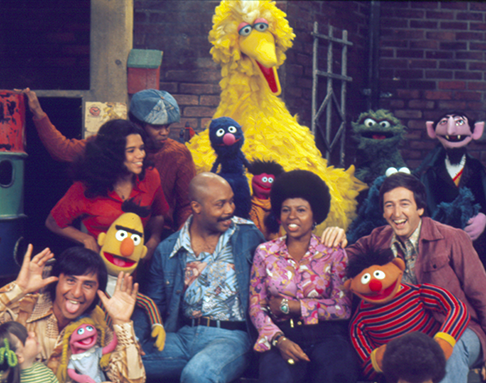
Equally groundbreaking was the show’s urban representation and diversity. Set in a vibrant New York City brownstone neighborhood, complete with stoops, storefronts, and communal spaces, the set reflected a real, living community. Children saw diverse residents – adults and peers of different races, ethnicities, and backgrounds – interacting respectfully, solving problems, and supporting one another.4 For inner-city viewers, it was a positive reflection of their neighborhoods; for suburban children, it provided a window into communities they might not otherwise encounter, building empathy and understanding. The cast itself broke barriers, including white actors in minority roles and creating one of the first truly integrated ensembles on children’s television.
Positive Role Models and Inclusive Casting
The show’s brilliance was not limited to its visuals or cast. It spoke to children, never down to them, tackling difficult and sometimes emotional topics with care. When actress Sonia Manzano (Maria) became pregnant, the show used the opportunity to help children understand pregnancy and family changes. The death of actor Will Lee (Mr. Hooper) in 1982 became a gentle lesson about loss. Even Big Bird’s imaginary friend, Mr. Snuffleupagus, was revealed as real in 1985, reinforcing to children that adults could be trusted in serious matters.
Addressing Real-Life Challenges for Kids
Sesame Street also broke new ground with its willingness to depict real life. In 1977, it became the first show to portray breastfeeding on television. By the late 1980s, it addressed love, marriage, and childbirth at a time when few children’s books tackled these subjects. Beyond individual experiences, the show reflected broader social realities, responding thoughtfully to events like the attacks of 9/11, Hurricane Katrina, the COVID-19 pandemic, and the Black Lives Matter movement.6
The Lasting Impact on Children’s Television and Education
All of this was made possible through deliberate public investment. Funded by a combination of the Carnegie Corporation, the U.S. federal government via the Corporation for Public Broadcasting, and private foundations, the show’s creators ensured it would be freely available on PBS, reaching children regardless of socioeconomic status.7 In 2006 Sesame Street launched its You Tube channel, continuing its goal of reaching wider audiences on subscription-free platforms.

Through all of this, Sesame Street aimed to do more than educate – it sought to reshape perceptions. By presenting inner-city neighborhoods and diverse communities in a positive light, the show fostered self-esteem among Black viewers and encouraged tolerance and awareness among white viewers. Its research-driven educational programming helped bridge early learning gaps, giving disadvantaged children a stronger foundation and a fairer shot at academic success.
Sesame Street is more than a television show – it’s a cultural experiment, a classroom, and a community rolled into one. By marrying research-based pedagogy with warmth, humor, and respect for children, it redefined what television could accomplish and continues to inspire generations, proving that learning can be as engaging as it is essential.8
Disclosure: Some recommended reading links are Amazon affiliate links. If you choose to purchase through them, it helps support Off Beat History at no additional cost to you. Books are only included when they directly support the research and storytelling in the article
The Footnotes That Matter
Street Gang: The Complete History of Sesame Street by Michael Davis A definitive history of the show’s creation, including profiles of Joan Ganz Cooney, Lloyd Morrisett, Jim Henson, and key milestones.
Sunny Days: The Children’s Television Revolution That Changed America by David Kamp Captures the unique political and social moment that gave us not only Sesame Street, but also Fred Rogers’s gentle yet brave Mister Rogers’ Neighborhood
G is for Growing: Thirty Years of Research on Children and Sesame Street edited by Shalom M. Fisch and Rosemarie T. Truglio A collection and synthesis of key research studies since the program’s inception over three decades ago–serves as a marker of the significant role that Sesame Street plays in the education and socialization of young children.
Children’s Television: The First Thirty-Five Years, 1946-1981 by George W. Woolery Contextualizes Sesame Street within the broader history of children’s programming.
References
1. Cooney, J. et al. “Early Childhood Television Viewing and Academic Skills.” Journal of Applied Developmental Psychology, 1988
2. Fisch, Shalom M., and Rosemarie T. Truglio, eds. “G” is for Growing: Thirty Years of Research on Children and Sesame Street. Mahwah, NJ: Lawrence Erlbaum Associates, 2001
3. Lattman, Sara. “’Sesame Street; Turns 50: The Secret to Educational Success at TV’s Beloved Address.” 7 Nov 2019. https://dornsife.usc.edu/news/stories/50th-anniversary-of-sesame-street/
4. Lattman, Sara. “’Sesame Street; Turns 50: The Secret to Educational Success at TV’s Beloved Address”
5. Long, Loretta. “Sesame Street: A Space Age Approach to Education for Space Age Children.” Aug 1973. p. 125. https://scholarworks.umass.edu/entities/publication/d23ff933-7ec8-4ca5-a780-8c27c44144dc
6. Truglio, Rosemarie T. “It’s More than Entertainment: Educational and Social Messages in Sesame Street.” Harvard Educational Review, 1987
7. Cooney, J., & McCarty, T. “Funding and Access: The Early Years of Sesame Street.” Journal of Communication, 1979
8. Davis, Michael. “Street Gang: The Complete History of Sesame Street” Penguin Books (2008)
Leave a Reply