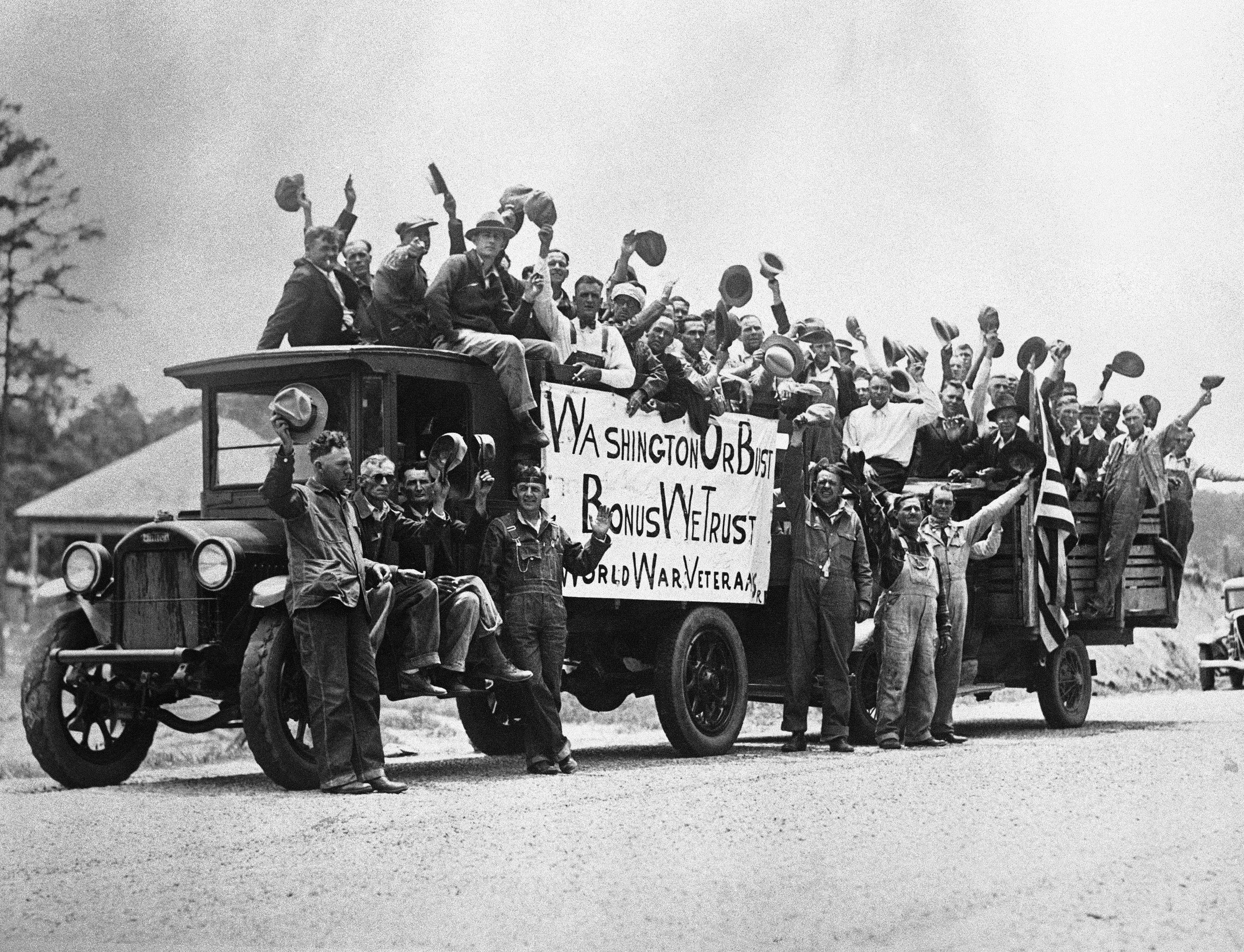
In the summer of 1932, tens of thousands of World War I veterans – jobless, hungry, and desperate – descended on Washington, D.C., carrying a single demand: the bonus Congress had promised them years earlier. They weren’t agitators or radicals; they were men who had fought and survived, now forced to fight again – this time for recognition and survival.
On the Anacostia Flats, they built shantytowns with their families beside them, waving banners, sharing stories of war, and clinging to the hope that their country would honor its word. Instead, they faced suspicion, political fear, and eventually, tanks and tear gas.
This is the story of the Bonus Army: veterans pushed to the margins, overlooked and dismissed, yet determined to make their voices heard. It is a story of courage, injustice, and the human cost of promises broken – a reminder that even heroes can be forced to the edges of society when the system turns its back.

Bonus Army demonstration at the Capitol plaza, 1932
Veterans and the Promise of a Bonus
For much of American history, veterans were honored for their service but rarely treated as a distinct social group with specific needs. Before World War I, benefits were limited to pensions, and reintegration into civilian life was largely left to chance. For many, the war was not just a duty fulfilled – it was a transformative experience that altered their identities in ways only fellow veterans could understand. Their service was no longer just a chapter in their lives; it had become a defining part of who they were. By the 1920s, these men – once celebrated as heroes – found themselves navigating a society unprepared to acknowledge the full scope of their sacrifices.
The Great Depression Hits
In 1924, Congress passed the “Adjusted Compensation Act,” promising World War I veterans a bonus: $1.25 per day served overseas and $1.00 per day for stateside service. Veterans owed $50 or less were paid immediately, while the rest received certificates with 4% interest and an additional 25% to be collected in 1945. On paper, it looked fair – but the stock market crash of 1929 and the ensuing Depression left many veterans in desperate need of those funds long before 1945. Attempts to cash in early were thwarted. By 1927, veterans were allowed to borrow against their bonuses, but banks had no credit to give.
Political resistance complicated matters further. Presidents Harding, Coolidge, and Hoover all had reasons to oppose immediate payouts. President Warren G. Harding dealt with financial scandals in his cabinet that distracted him from veteran compensation. President Calvin Coolidge, a fiscal conservative, refused to burden future generations with the bill, famously declaring, “Patriotism which is bought and paid for is not patriotism.” President Herbert Hoover worried about Communist infiltration and the potential for a Bolshevik-style uprising. Though the economic recession of the early 1920s was largely over, these leaders maintained a firm stance: the veterans would have to wait. Yet veterans saw only betrayal: their government had funds for corporate bailouts but not for those who’d served.
Formation of the Bonus Expeditionary Force
By 1932, desperation had grown. Loans against the bonuses were theoretically possible beginning in 1927, but banks, starved of credit during the Depression, were unable to provide relief. Out of frustration, jobless veterans formed the Bonus Expeditionary Force (BEF) in May 1932.
Their plan was simple: march on Washington, D.C., and demand the bonuses promised to them years earlier. Led by Walter W. Walters, thousands of jobless veterans – many accompanied by families – converged on Washington. They erected a sprawling shantytown at Anacostia Flats, a grim contrast to the Capitol’s marble grandeur.
Life in the Anacostia Camps

By summer, an estimated 20,000 to 30,000 veterans, along with their families, had joined the camps. Not all arrivals were veterans, however, and the presence of opportunists and agitators allowed President Hoover to dismiss the BEF as a radical threat. “The march was largely organized and promoted by Communists,” he claimed, “and included hoodlums and ex-convicts bent on raising a public disturbance.” Yet a Veterans Administration survey later revealed that 94% of those in the camps had indeed served in the Army or Navy, 67% had seen combat, and one in five carried disabling injuries from the war. Despite their sacrifices, they were treated with suspicion.
Buffalo Soldiers and Racial Dynamics

Racial tensions complicated matters further. Many African American veterans, including Buffalo Soldiers, a name once bestowed by Native tribes in the 1890s, faced hostility from those who saw them as competitors for scarce jobs.
Despite their wartime sacrifices, they faced racist accusations of squandering bonuses or stealing jobs – a bitter irony in an economy where no work existed.
U.S. veterans are shown during the Bonus March on Washington, July 28, 1932. (AP Photo)
Timing and social context also worked against the veterans. The postwar economy had been unstable, and isolationist sentiment ran deep. Many Americans still believed entering the Great War was a mistake – Gallup polls suggested 70% agreed with this view. Veterans themselves were simply trying to survive in a nation that seemed to have moved on without them.
The BEF’s resolve hardened as Congress debated the Patman Bill. Tensions climaxed on June 15, when Rep. Edward Eslick, a vocal supporter, collapsed mid-speech and died of a heart attack. His final words – a rebuke of lawmakers prioritizing corporations over veterans – echoed through the chamber. When Congress refused to act on the Patman Bill, frustrations boiled over. The BEF refused to leave, maintaining a visible presence to remind lawmakers of their plight. Tensions peaked at the end of July when authorities moved to evict them.
Hoover, MacArthur, and the “Battle of Washington”
Initially, the government allowed piecemeal eviction from unsafe buildings. But Attorney General William D. Mitchell eventually ordered a full-scale clearance. Major General Douglas MacArthur, ignoring the fact that these were decorated veterans, treated the protest as a military threat.
In a dramatic show of force, he deployed 200 cavalrymen with bayonets, tanks, and heavily armed infantry, unleashing tear gas and fire along Pennsylvania Avenue. The chaos, later dubbed “The Battle of Washington”, swept up veterans, families, and innocent bystanders alike. Two veterans, William Hushka, a 35-year-old immigrant from Lithuania, and Eric Carlson, a 38-year-old veteran from California, were killed, buried later with honors in Arlington National Cemetery.

In Washington, D.C., a cavalry led by Major George S. Patton routed an “army” of his fellow World War I veterans, their wives and children, who protested to beseech Congress for promised bonuses, 1932. (AP Photo)
Aftermath and Legacy


(left) A federal soldier passes by burning shacks that fleeing Bonus March veterans abandoned, at Camp Marks, on the Anacostia Flats in Washington, D.C., July 29, 1932. This was the fourth veterans’ camp to be burned. (AP Photo) (right) Washington police attempting to remove Bonus Army marchers from federal property – July 28, 1932
MacArthur and his aides justified the attack, convinced the veterans were Communist agitators, despite overwhelming evidence to the contrary. Although George Patton recognized some of the veterans personally, loyalty and wartime bonds could not soften the military’s approach. Hoover’s intransigence and fear of political fallout had triumphed over empathy. By dawn, the camp lay in ashes, and the nation recoiled at images of soldiers trampling veterans under the flag they’d once defended.
Fort Hunt and Roosevelt’s Response
Contrast this with Franklin D. Roosevelt’s approach. Though he did not immediately support direct bonus payments, he treated veterans with dignity, providing meals, lodging, and work opportunities through the Civilian Conservation Corps. He established a tent city at Fort Hunt in Fairfax County, Virginia, demonstrating a more humane, pragmatic, and effective method of addressing veterans’ needs. By 1936, Congress overrode a veto, releasing $2 billion in bonuses – too late for many, but a testament to the BEF’s enduring impact.

The story of the Bonus Army is a cautionary tale about promises, politics, and human dignity. Veterans marched not for ideology, not for power, but for a basic recognition of their service – a small measure of justice delayed for too long.
It reminds us that the people who fight are not simply tools of the state; they are individuals whose service reshapes their lives. Their march, their camps, and the violent eviction highlight the disconnect between the men who had fought for their country and the government that struggled to honor that sacrifice.
And perhaps today, as our own capital wrestles with demonstrations, occupations, and political standoffs, the march of the Bonus Army feels eerily familiar. It reminds us that the heart of a nation can sometimes be found not in its chambers of power, but in the voices of those demanding to be seen, heard, and honored.
Bonus Army on the Capitol lawn, 1932
Disclosure: Some recommended reading links are Amazon affiliate links. If you choose to purchase through them, it helps support Off Beat History at no additional cost to you. Books are only included when they directly support the research and storytelling in the article.
Unlock the Archives
Books
The Bonus Army: An American Epic by Paul Dickson and Thomas B. Allen Comprehensive narrative history of the Bonus Army, including veterans’ personal stories, political context, and the military eviction.
The Great Depression: America, 1929–1941 by Robert S. McElvaine Provides context for the economic hardships that fueled the Bonus Army march and broader veterans’ struggles.
Marching on Washington: The Forging of an American Political Tradition by Lucy G. Barber Describes how these highly visible events contributed to the development of a broader and more inclusive view of American citizenship and transformed the capital from the exclusive domain of politicians and officials into a national stage for American citizens to participate directly in national politics
Primary Sources
Letter from Walter W. Waters, Bonus Army Leader, to President Hoover (1932) A firsthand account of the veterans’ demands and the conditions in the camps.
Veterans Administration Survey of Bonus Marchers (1932) Provides statistics on who participated: combat experience, injuries, and service.
Articles & Online Resources
The 1932 Bonus Army: Black and White Americans Unite Prologue Blog, National Archives Highlights racial dynamics, the inclusion of Buffalo Soldiers, and veterans’ unity.
Multimedia
Bonus Marchers of 1932 Radio Diaries / WBEZ Audio feature focusing on personal stories of the veterans’ march.
References
Burgess, Rebecca. “Beyond the ‘Broken Veteran’: A History of America’s Relationship with It’s Ex-Soldiers.” 7 Mar 2018. https://warontherocks.com/2018/03/beyond-the-broken-veteran-a-history-of-americas-relationship-with-its-ex-soldiers/
“The Senate and the Bonus Expeditionary Forces of 1932.” United States Senate. 9 Nov 2023. https://www.senate.gov/artandhistory/senate-stories/senate-and-the-bonus-expeditionary-force-of-1932.htm
National Park Service. “The 1932 Bonus Army.” Last updated 25 July 2023. https://www.nps.gov/articles/the-1932-bonus-army.htm
PBS. “The Bonus March (May-July 1932).” Accessed 19 September 2025.” https://www.pbs.org/wgbh/americanexperience/features/macarthur-bonus-march-may-july-1932/
Kingseed, Wyatt. Military History. “Eisenhower, Patton, and MacArthur and the Stain of the ‘Bonus Army.’”28 Jul 2025. https://www.militarytimes.com/veterans/military-history/2025/07/28/eisenhower-patton-and-macarthur-and-the-stain-of-the-bonus-army/
“Bonus Bill Becomes Law.”The New York Times. January 28, 1936. Retrieved 19 Sep 2025. https://www.nytimes.com/1936/01/28/archives/bonus-bill-becomes-law-repassed-in-senate-7619-payment-will-be.html
Leave a Reply