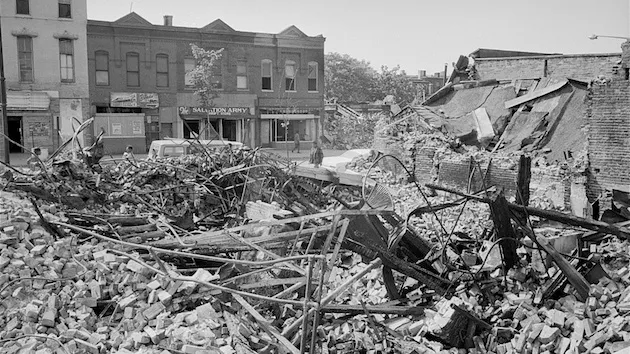
Leadership in the 1968 Washington, D.C. Riots
When the news broke that Martin Luther King Jr. had been assassinated, Washington, D.C. erupted in what would become one of the defining uprisings of 1968 – an eruption that seemed to threaten everything King had preached about nonviolence and beloved community. But what followed was a quieter, less visible miracle: the city’s leaders held fast to the very principles King embodied. Mayor Walter Washington stepped into the streets rather than calling for crackdowns, and President Lyndon B. Johnson resisted the instinct to flood the capital with force. At a time when the nation expected a display of strength, they chose something far braver: restraint. Their steadiness during those few harrowing days would help transform chaos into reform.
The Night the Dream Was Shattered

The news crackled across radio and television on that April evening in 1968: Martin Luther King Jr., the apostle of nonviolence, had been gunned down on a motel balcony in Memphis.
In Washington, D.C. – a city that had heard his “I Have a Dream” echo across the National Mall just five years earlier – the unthinkable became reality. The grief was instant, and the anger followed just as quickly.
What erupted was not one of King’s carefully organized marches but something far more visceral. Blocks ignited in a fury of broken windows, looted storefronts, and fire-lit skies.
The nation’s capital, so often a symbol of order and power, suddenly exposed its deepest wounds. These were not random acts; they were the sound of a community grappling with the loss of its most steady moral guide.
A Mayor in the Streets, Not Behind the Lines
At the center of that chaos stood Mayor Walter Washington, one of the first African American mayors of any major U.S. city. Emergency calls poured in – more than 900 in those first days – and he moved quickly to impose a curfew and request federal support.
But even in urgency, Washington made deliberate choices. He refused to barricade himself in an office surrounded by police. Instead, he walked the streets, talking with residents face-to-face. He understood instinctively that a city in mourning needed presence, not intimidation

Lessons in Leadership During Civil Unrest
President Lyndon B. Johnson faced his own test. Pressure mounted immediately for him to deploy federal troops, to reassert control with a decisive show of force. Johnson did the opposite. He watched, listened to Civil Rights leaders, and gave D.C. the chance to stabilize itself.
Even as pressure mounted to deploy federal troops immediately, he waited to see if the city could heal itself. Only when local authorities were clearly overwhelmed did he authorize 4,000 National Guard troops to enter the capital.
The first time troops had been ordered to the Capitol for a civil disturbance since 1932.
Even then, his concern wasn’t just about restoring order; it was about how that order would be restored. He declared a national day of mourning and ordered flags lowered to half-mast, acknowledging that the nation had lost not just a leader, but a piece of its soul.
Johnson reached out to mayors across the country, urging them to serve as anchors for their communities rather than commanders of occupied territory. Too many local leaders, he worried, were preparing for war when what was needed was healing. He warned against unnecessary force, reminding leaders that people mourning a hero were not enemies of the state.


A Dangerous Demand: Hoover’s Push for Lethal Force
Walter Washington exemplified that message. His clearest test came when FBI Director J. Edgar Hoover pressed him to authorize National Guard troops to shoot looters. Washington flatly refused. He would not turn a devastated city into a battlefield. Property could be repaired; a broken relationship between residents and their government would take generations to mend. His refusal was a moral line in the sand, one that would later help propel the movement for D.C. Home Rule and Washington would become the city’s first elected mayor in 1974.
Out of the Flames: The Fair Housing Act Takes Shape
While the streets burned, something equally remarkable unfolded in the halls of Congress. Civil rights legislation – specifically fair housing protections that King himself had championed – had faced fierce opposition from segregationist senators. But when lawmakers returned that Monday after the riots, the political landscape had shifted overnight. Less than a week after King’s assassination, the Senate approved and Johnson signed the Civil Rights Act of 1968, including the Fair Housing Act.
Debate was bitter. Some legislators accused Congress of surrendering to “mob violence,” but others recognized the deeper truth: America had ignored unequal housing conditions for far too long, and the destruction on the streets reflected decades of accumulated injustice. Passing the bill became both a tribute to King and an acknowledgement that the rage consuming American cities stemmed from real, systemic failures.
The Fair Housing Act represented something King had understood from the beginning: that civil rights weren’t just about where you could sit on a bus or eat lunch, but about the fundamental right to build a life anywhere your talents and dreams could take you. Housing discrimination had trapped African American families in deteriorating neighborhoods, cutting them off from quality schools, job opportunities, and the chance to build generational wealth.
The week that began with a single, devastating act of violence ended with a major civil rights victory – one that widened access to housing and challenged the very inequalities that had fueled the unrest. The Fair Housing Act did not heal every wound, but it represented forward motion in a moment when the country seemed to be tearing itself apart.

The Lessons Leaders Forgot – and We Still Need
History doesn’t repeat itself neatly, but it does offer warnings and blueprints. In 1968, calm leadership prevented a devastated city from becoming an occupied one. Dr. King’s death could have plunged Washington into a true occupation, yet, in that dark week, leadership mattered. It mattered that Washington walked among his people instead of hiding behind troops. It mattered that Johnson waited, refusing to treat American citizens as an occupying force might treat foreign enemies. Their choices didn’t erase the pain of King’s death, but they prevented greater tragedy and helped transform grief into reform.
Dr. King often spoke of the “fierce urgency of now.” In the days following his assassination, that urgency manifested not only in flames and shattered glass but in the calm, steady actions of leaders who refused to escalate a wounded city into a war zone. It’s a lesson worth remembering; a city can be steadied without being subdued, and leadership can rise to meet crisis without turning against the people it serves.
The dream King carried proved stronger than the violence that threatened to snuff it out. And in a week defined by loss, the nation still found a way to take a step – small, imperfect, but real – toward the justice he envisioned.
Another Moment When D.C. Reached Its Breaking Point
History doesn’t just repeat itself – it circles back through the same streets.
If this story resonated, explore how Washington, D.C. faced a different crisis three decades earlier, when thousands of World War I veterans marched on the capital demanding justice.
👉 Read: The Bonus Army, 1932: Forgotten Heroes of the Great Depression
Disclosure: Some recommended reading links are Amazon affiliate links. If you choose to purchase through them, it helps support Off Beat History at no additional cost to you. Books are only included when they directly support the research and storytelling in the article.
If You Want to Dig Deeper to Understand 1968
Judgment Days: Lyndon Baines Johnson, Martin Luther King Jr., and the Laws That Changed America by NIck Kotz The first comprehensive account of the relationship between President Johnson and Martin Luther King uses FBI wiretaps, Johnson’s taped telephone conversations, and previously undisclosed communications between the two to paint a fascinating portrait of this important relationship.
At Canaan’s Edge: America in the King Years, 1965–1968 by Taylor Branch A definitive account of King’s final years, including detailed narrative on the riots and Johnson’s political response.
The Color of Law: A Forgotten History of How Our Government Segregated America by Richard Rothstein Necessary reading for understanding housing segregation and the roots of frustration that made the Fair Housing Act so critical.
Most of 14th Street is Gone:The Washington, D.C. Riots of 1968 by J. Samuel Walker An in-depth look at the causes and consequences of the Washington, DC riots of 1968 using archival materials and first-hand accounts.
References
Martin Luther King Jr.’s Assassination Sparked Uprisings in Cities Across America https://www.smithsonianmag.com/history/martin-luther-king-jrs-assassination-sparked-uprisings-cities-across-america-180968665/#:~:text=The%20riots%20that%20followed%20the%20assassination%20of,opportunities%20*%20Discrimination%20in%20the%20job%20market
How D.C.’s History Leaves Home Rule Vulnerable to Federal Interference https://wamu.org/story/25/05/29/dc-history-home-rule-federal-interference/
Metropolitan Police Department of the District of Columbia 1968 Riots Documents, DC Public Library, https://digdc.dclibrary.org/do/fdb59bff-a5a1-4aca-9e5a-b8995924b251?utm_source=chatgpt.com
Remarks Upon Signing the Civil Rights Act of 1968, LBJ Presidential Library, https://www.lbjlibrary.org/object/text/remarks-upon-signing-civil-rights-act-1968?utm_source=chatgpt.com
Leave a Reply